Leveraging Deep Neural Networks for Enhanced Otitis Media Diagnosis
At a glance
| Problem | Ear infections (otitis media) are common in children, but reading otoscope images is subjective and often wrong. |
|---|---|
| Idea | Combine four different CNNs and add patient details (age, symptoms, history) to the image. |
| Result | 92.56% accuracy and 96.12% sensitivity, better than every single model and classic benchmarks. |
| Clinical check | 200 held-out cases compared with ENT specialists: strong agreement (κ = 0.85) |
| Tech | PyTorch, RegNet-X 16GF and 3.2GF, MobileNetV2, ResNeXt50 32×4d, AdamW |
| Published in | 2026 International Conference on Emerging Systems and Intelligent Computing (ESIC) |
| Where & when | February 2026 · Bhubaneswar, India |
| Publisher | IEEE (2026) |
How it works
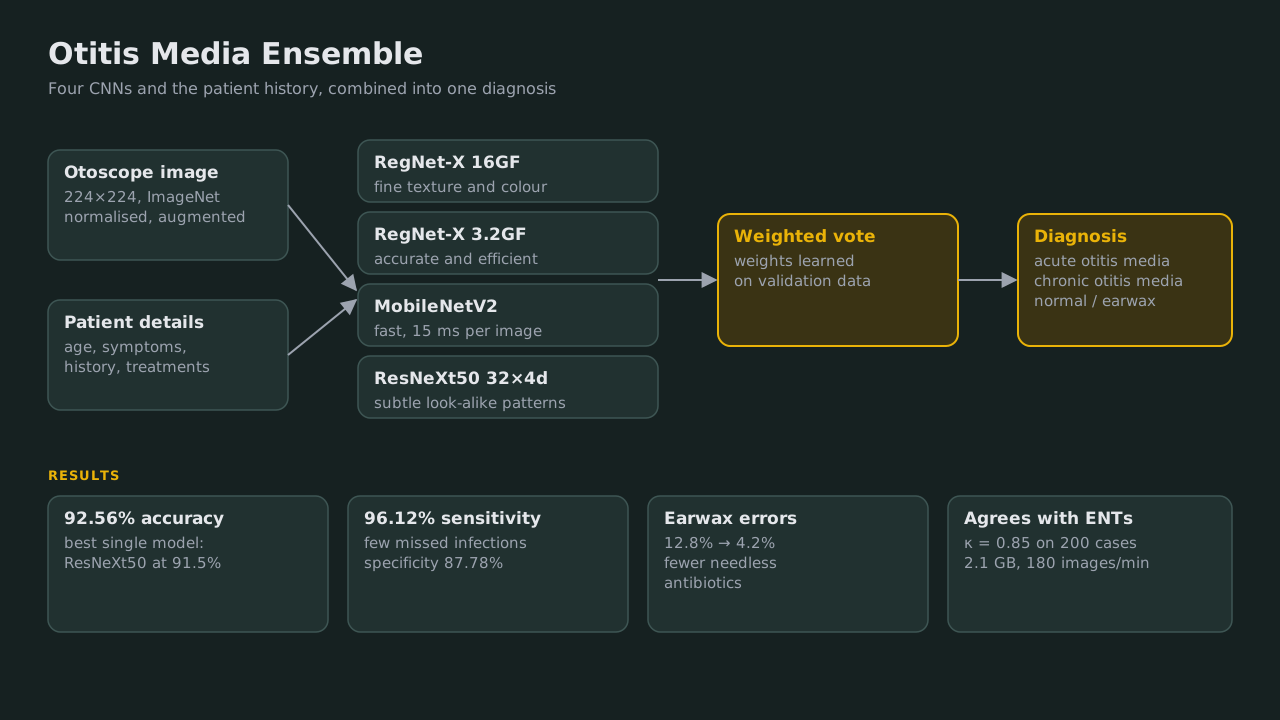
- Otoscope image+ patient details
- Preprocess224×224, augment
- 4 CNNsrun in parallel
- Weighted votelearned weights
- Diagnosisacute, chronic or normal
Key points
- Each model brings a different strength: fine texture (RegNet 16GF), efficiency (RegNet 3.2GF), speed (MobileNetV2), subtle patterns (ResNeXt)
- Their predictions are merged with learned weights tuned on validation data
- Patient metadata is encoded next to the image, the way a doctor uses both
- Earwax wrongly called an infection dropped from 12.8% to 4.2%, which avoids needless antibiotics
- Runs on a normal clinic PC: 2.1 GB memory, about 180 images a minute
Results
| Model | Accuracy | Precision | Recall | F1 |
|---|---|---|---|---|
| Ensemble (this paper) | 92.56% | 90.3% | 90.1% | 90.2% |
| ResNeXt50 32×4d | 91.5% | 89.6% | 89.4% | 89.5% |
| RegNet-X 16GF | 90.8% | 89.0% | 88.7% | 88.9% |
| MobileNetV2 | 89.2% | 88.1% | 87.8% | 88.0% |
| Model | Accuracy | Sensitivity | Specificity |
|---|---|---|---|
| Ensemble (this paper) | 92.56% | 96.12% | 87.78% |
| ResNet-50 | 88-91% | 89.2% | 85.1% |
| DenseNet-121 | 84-92% | 90.1% | 83.7% |
| VGG16 | 88-90% | 87.9% | 84.2% |
| Inception V3 | 85-90% | 88.5% | 82.3% |
Architecture
More numbers and details
- Acute vs chronic otitis media separated at 93% and 91% accuracy
- Missed urgent cases cut to 3.1%
- Training: ImageNet weights, AdamW (lr 0.001, weight decay 0.01), cosine schedule, label smoothing 0.1, dropout 0.3
- Augmentation: ±15° rotation, flips, ±20% brightness, ±15% contrast, 0.8-1.2× zoom
- Gains over single models are statistically significant (p < 0.001)
- MobileNetV2 alone takes about 15 ms per image
- Deep Learning
- Ensemble Learning
- Computer Vision
- Healthcare AI
- Medical Imaging